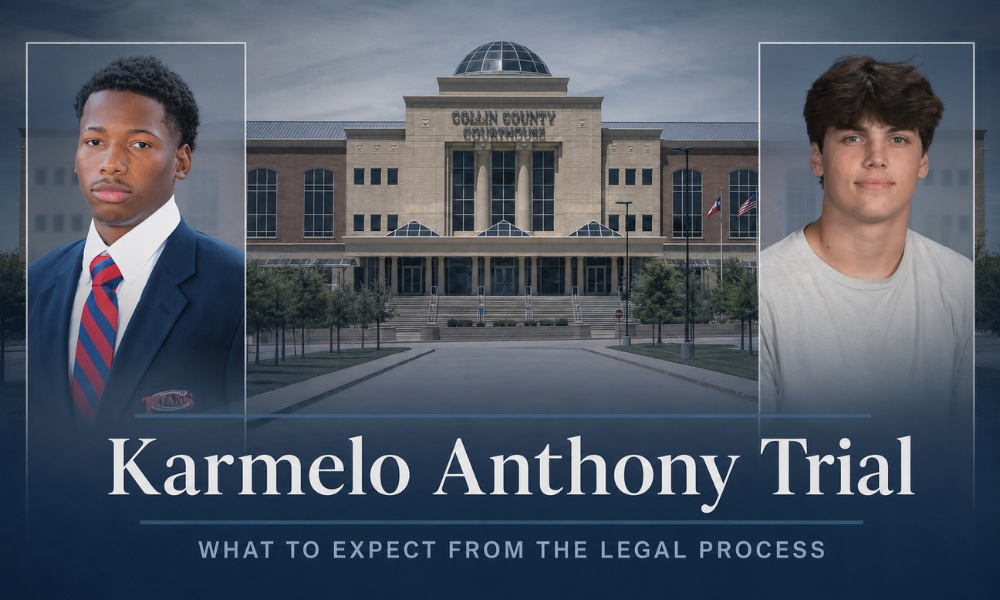
The murder trial of Karmelo Anthony began Monday in Collin County with jury selection, opening the next legal chapter in one of the most painful and closely watched Texas high school sports stories in recent memory.
Anthony is accused of fatally stabbing 17-year-old Austin Metcalf during a Frisco ISD track meet in April 2025. He has pleaded not guilty, and his defense is expected to argue self-defense. Metcalf, a Frisco Memorial High School student and Texas high school football player, died after the confrontation. Anthony, who attended Frisco Centennial High School, was also a high school athlete and football player.
This is a case that has carried grief, anger, fear, racial tension, legal complexity, and a heavy public spotlight. At the center of it are two families forever changed. One family is mourning a son, brother, teammate, and student. The other is watching a teenager face a first-degree murder charge that could reshape the rest of his life.
That is why this trial needs to be discussed carefully.
Anthony is presumed innocent unless and until proven guilty in court. Metcalf’s death is also an undeniable tragedy. Both realities can be true at the same time.
What Happens First In The Trial
The trial began with jury selection on June 1. Opening statements could begin as early as Thursday, June 4, depending on how quickly attorneys and the judge finalize the jury. The trial is expected to last roughly two weeks.
Jury selection may be one of the most important parts of this case.
In a normal criminal trial, attorneys try to identify jurors who can listen fairly, follow the law, and separate evidence from opinion. In this case, that process becomes harder because of how much attention the case has already received. Many potential jurors may have seen headlines, social media arguments, fundraising campaigns, commentary videos, or online rumors.
The attorneys will likely ask potential jurors about what they have heard, whether they have formed opinions, whether they can consider self-defense fairly, and whether they can put aside outside narratives. The goal is not to find jurors who know nothing. In a case this public, that may be difficult. The goal is to find jurors who can judge only what is presented in court.
Once the jury is seated, the prosecution will give its opening statement first. Prosecutors will outline what they believe the evidence will show. The defense will then give its opening statement, explaining why it believes the evidence supports Anthony’s claim of self-defense.
Opening statements are not evidence. They are road maps. Still, in a case built around one fast-moving confrontation, those first road maps could matter a lot.
The Core Legal Question
The central question is not simply whether Anthony stabbed Metcalf. The legal question is whether the state can prove beyond a reasonable doubt that the stabbing was murder and not legally justified self-defense.
That distinction matters.
In Texas, prosecutors carry the burden of proof. Anthony does not have to prove his innocence. Once self-defense is raised, prosecutors must convince jurors beyond a reasonable doubt that the use of deadly force was not justified under the law.
The prosecution is expected to argue that Metcalf was unarmed, that the confrontation began over seating under a team tent, and that using a knife in that situation was not legally reasonable. Police have said the dispute involved Metcalf telling Anthony to leave a team area before the confrontation escalated.
The defense is expected to argue that Anthony believed he was being physically threatened and acted to protect himself. Reports from the case have said Anthony made statements after the incident suggesting he believed he had defended himself.
That is where the jury will have to focus.
Did Anthony reasonably believe deadly force was immediately necessary? Did he provoke or escalate the confrontation? Was the response legally proportional? What exactly happened in the seconds before the stabbing?
Those seconds may define the entire trial.
What The Prosecution Will Likely Emphasize
The prosecution will likely build its case around eyewitness testimony, stadium video, police reports and the medical evidence.
Jurors may hear from students, coaches, law enforcement officers, medical personnel and possibly others who were at the track meet. They may see video from the stadium if the court allows it into evidence. They may also hear testimony about the knife, the location of the wound and the efforts to save Metcalf.
Supporters of Metcalf have consistently argued that this was not self-defense. Their view is that Metcalf was unarmed, that the dispute should never have turned deadly and that bringing a knife into a school event changes the entire legal and moral picture.
They also point to Metcalf’s life beyond the incident. He was a Frisco Memorial football player, a linebacker, a strong student and an identical twin. His family has described him as a dedicated athlete and student with a bright future. His twin brother, Hunter, later accepted Austin’s diploma after his death.
For Metcalf’s family and supporters, the trial is about accountability for the death of a teenager who went to a school event and never came home.
That grief will be present, even if the courtroom rules require silence.
What Anthony’s Defense Will Likely Argue
Anthony’s defenders have focused on self-defense, context and caution against rushing to judgment.
They argue that the public has not heard the full story and that the confrontation should not be reduced to a headline. The defense is expected to focus on whether Metcalf made physical contact first, whether Anthony felt trapped or threatened and whether the circumstances created a reasonable fear in that moment.
Supporters of Anthony also point to his background before the case. He was a Frisco Centennial student-athlete, reportedly had no prior criminal history and was involved in football and track. They argue that the public portrayal of him has often been harsh, incomplete and shaped by emotion before evidence has been tested in court.
Some defenders also believe the case has been shaped by race and public pressure. Anthony is Black, and Metcalf was white. The case has drawn national attention, protests and highly charged commentary. Supporters of Anthony have argued that racial bias may affect how the case is discussed and perceived outside the courtroom.
Those claims will not decide the verdict by themselves. Jurors will be asked to decide the legal questions based on the evidence. Still, those broader tensions explain why the judge has placed such tight controls around the proceedings.
Why The Judge Set Strict Rules
Judge John Roach has issued strict courtroom and media rules for the trial. Those rules include limits on recording, photography, media access, and courtroom behavior. The purpose is to protect jurors, witnesses, attorneys, the families, and the fairness of the trial itself.
That matters because this case has already created intense public reaction.
High-profile trials can become distorted by outside noise. Social media can spread half-truths quickly. People can form strong opinions before hearing sworn testimony. Witnesses can feel pressure. Jurors can feel watched.
The judge’s job is to keep the courtroom from becoming a stage.
Expect strict control over who enters, when people enter, where media can be positioned and how spectators behave. Emotional reactions inside the courtroom may not be tolerated. That may sound severe, but in a case this tense, the court will try to prevent anything that could influence the jury or create security risks.
Could There Be Lesser Charges?
Although Anthony is charged with first-degree murder, the final jury instructions could become very important.
In some murder trials, jurors may be allowed to consider lesser included offenses, depending on the evidence and the judge’s rulings. That could include something like manslaughter if the evidence supports it. This does not mean a lesser charge will definitely be offered to jurors. It means the legal arguments near the end of trial could shape what options the jury has.
That part often happens after both sides present their evidence. Attorneys argue over the exact wording of the jury charge. The judge then decides what legal instructions the jury receives.
Those instructions matter because jurors do not simply vote based on emotion. They must apply the law as the judge gives it to them.
If the jury is instructed only on murder and self-defense, the decision could be more direct. If lesser offenses are included, jurors may have more possible outcomes to consider.
What The Jury Must Decide
After evidence and closing arguments, the jury will deliberate privately.
In a Texas criminal case, the verdict must be unanimous. All 12 jurors must agree to convict. All 12 must agree to acquit. If they cannot agree, the judge could eventually declare a mistrial. If that happened, prosecutors would then decide whether to retry the case.
If Anthony is convicted of murder, the case would move into sentencing. Because he was 17 at the time of the incident, the punishment rules differ from those for older adult defendants in the most severe categories. Reports indicate he faces the possibility of a lengthy prison sentence if convicted.
If he is acquitted on self-defense grounds, he would be legally cleared of the charge.
Both outcomes would carry enormous emotional weight.
Two Football Communities Changed
This case has also touched Texas high school football in a painful way.
Metcalf was not just a name in a legal filing. He was a Texas high school football player at Frisco Memorial. He had teammates, coaches, a jersey number, a twin brother beside him, and a future people were excited to watch unfold.
Anthony was also part of the Texas high school athletic world. He played football at Frisco Centennial and was known as a student-athlete before the case changed the course of his life.
That overlap is part of why the story has hit so hard. Texas high school sports are supposed to be about competition, community and young people growing through pressure. This case began at a school athletic event and ended in the worst possible way.
No article, trial or verdict can restore what was lost.
But the legal process can still matter. It can give evidence a structure. It can give both sides a chance to be heard. It can force arguments to be tested under rules instead of online outrage.
What To Watch From Here
The first major thing to watch is jury selection. If seating a jury takes longer than expected, opening statements could be delayed. If a jury is seated quickly, the trial may move into testimony by the end of the week.
Next, watch how each side frames the confrontation.
The prosecution will likely focus on the knife, the location of the wound, Metcalf being unarmed, and whether Anthony’s response was legally unjustified. The defense will likely focus on the physical contact, Anthony’s perception of danger, and whether the state can truly disprove self-defense beyond a reasonable doubt.
Also, watch the judge’s rulings on evidence. What video is shown? Which statements come in? Which witnesses are allowed to testify about what they saw, heard or believed? These rulings can shape how jurors understand the timeline.
Finally, watch the jury instructions. Near the end of trial, the exact legal wording given to jurors may become one of the most important moments in the case.
For now, the trial is beginning where it should begin: with jurors, evidence, and the presumption of innocence.
The public may already have opinions. The courtroom has a different job.